Thursday, 22 February 2018

A lovely winter's day Stapleford to Beeston walk and I feel on top of the world!

Life at the moment is full of contradictions. I was recently reminded by my hospital doctor that I am terminally ill (with ideopathic lung disease) and could find myself falling off a cliff without much warning, yet right now I continue to walk without any sign of breathlessness or tiredness and feel on top of the world. What one lucky bunny I am!

This morning I went to my dentist at Stapleford Health Centre and after a cup coffee I set out to walk home along public footpaths, and dead end lanes and roads. My friend Richard who lives in Beeston works in Stapleford and walks between the two towns weather permitting. You can follow my route on the three maps below, which have been created using Open Street Map thanks to all the work done by their Nottingham volunteers, who have created the base map.

This is more like a picture essay with (unusually for me!) not much text. It took me just over an hour to walk. I did not see another person from the moment I climbed the steps outside Stapleford Health Centre (pic no.2) to getting home, except for a family of four on Common Lane near Southfields Farm and two cyclists who passed me.


1. Stapleford Library


2. Turn 180º and climb the ramp. About 200 yards and you reach Nottingham Road. 


3. Cross Nottingham Road and turn right up Cliff Hill Road, which is quite narrow. 


4. About 100 yards along is this footpath to the left between a blank wall and a house. 


5. At the end of building in pic.4 are these allotments. I will come back in the high summer when the view will be very different I'm sure.


6. Stapleford Cemetery is on both sides of the footpath running towards the A52, Bramcote and Beeston. I am assuming these 'bushes' are yew. Some encase gravestones. I have not seen anything quite them before.  The building to the left is the cemetery's listed chapel and mortuary and dates from 1880. Here is a link to the Historic England listing.


7. The muddy path across a ploughed field from the cemetery towards the bridge across the A52. The farmer does not plant the footpath strip, nor is it anything but tufts of grass and earth. I had stout urban walking shoes on, but walking boots would have been better!


8. Looking back towards Stapleford Cemetery. The hedge stops about half way across and this is the state of the unsigned public footpath. It is the only section of the walk not suitable for urban walking shoes after it has been raining. Ideally, this strip needs a gravel path. It doesn't have to be wide, but if there was such a path this would make an excellent all-year walking route between Stapleford, Bramcote and Beeston. 


9. These steps (and the gates of course) are what make this a walk not suitable for wheelchair users (and buggies which cannot be folded).


!0. From the steps in pic.9 you can see the bridges across the A52. At this point the road is no more than a low rumble.


11. The A52 from the bridge.


12. Across the A52 and to the left is this sign marking 'The Erewash Trail'. The only one I saw. At this point across the bridge the lane/track  goes to the right.


12 still. Then it turns left and across the fields you catch a distant glimpse of Chilwell and Inham Nook.


13. The lane/track may actually be Common Lane at this point. Maps are unclear, but the dog-leg takes you around Southfield Farm and you just keep on walking. It was on the stretch that a cyclist and and family opf four passed me.


14. This signage is a marker of sorts and is on the right-hand side of Common Lane.


14 still. Beneath the signposts this 'pothole' has been marked up I assume for filling. There are another half-dozen like this, but many more unmarked. What makes the marked ones different I have no idea. Perhaps its the size?


15. This is just one section of what once was a serious wall, now close to collapse in parts.


16. On the other side of Common Lane, a little further down, other small buildings are being reclaimed by nature.


17. The closer Common Lane is to Chilwell Lane the more large houses there are, so the lane is clear of mud. Not a single vehicle came along Chilwell Lane as I approached it...


18. ...and once across it remained deserted. This is its junction with Peache Way opposite Common Lane.


19. A fallen tree caught my attention. I liked the detail.


20. I love signs like this — an oxymoron of sorts — is a Christian heaven as exclusive as this? Is heaven littered with signage saying 'This is God's and it's private'?


21. Between here and Bramcote Drive it is pretty much a straight walk through rich modern suburbia on the southern edge of Bramcote village and then across Beeston Fields Golf Course...


22. ...All you have to do is hold your nerve and not doubt that you are on the right footpath. There are lots of high fences and walls. You are in a world where property owners/tenants value their privacy and (in fairness) security.


23. Keep on walking...


24. This a public footpath equivalent of a dog-leg junction. Go to the right and you get close to Cator Lane on the Chilwell side of Beeston...


25. ...At the other end follow the sign to Bramcote. I wonder why one public footpath junction has signage and the other one doesn't? In truth, the signage marking public footpaths is often absent and when it is there, at times, confusing!


26. Turn 180º at pic.25 and you are walking across Beeston Fields Golf Course.


27. The whole route to Bramcote Drive has a high wire mesh fence on either side. I like this no more than the footpath across the farmer's filed in Stapleford. I got the clear view by poking my camera through a gate lock opening. 


28. The same with this view of an up-to-date Tardis which is used to teleport golfers between greens and the Club House.


29. Bramcote Drive and Beeston comes into view. At this point I'm 10 minutes from home. Those of you walking onto Beeston have another 20 minutes ahead of you, and another map to look at.


30. The footpath's end (or beginning if you're going the other way) and Bramcote Road will take you into Beeston (see map below).


31. For me, it's a left turn and straight on. No more corners to turn, my home is dead ahead (as good as literally). I know the road well. I deliver 160+ newsletters and leaflets along it and off it for Beeston West Branch Labour Party.


32. Beeston Town Hall and bell tower close-up, the latter my favourite part of the building. It is difficult to appreciate with all the electronic gob-ons which surround it. The Conservatives who control Broxtowe Borough Council want to sell the Town Hall with little or no idea what might happen to it, beyond wild, optimistic, speculation. Beeston Civic Society is leading a campaign to keep the building as part of the council or transfer ownership to a Beeston based social enterprise, although as yet there appears to be no agreed vision as to its future. The Conservatives claim that it costs c.£500,000 in management and maintenance costs. Perhaps I will write a separate blog on the issue before too long.


 33. Beeston Library entrance, opposite Beeston Town Hall. The Library was refurbished in 2017.


34. Next to the Town Hall is a fine looking Roman Catholic church (The Church of the Assumption) with its square tower (above) and  this side door onto Foster Avenue which you cannot miss. If the church is open then it's worth a few minutes of your time. Modern Roman Catholic churches always seem appealing than their older counterparts (eg. the RC cathedral on Derby Road in Nottingham City City, although it does have a fine garden).


35. Beeston Square on a market day. There is no regular fixed market day, but most Saturdays there is something going on and, increasingly, on other days of the week too.


36. For the next few days this is a holding pic of a Trent Barton 18 bus, waiting to leave Beastmarket Hill in Nottingham City Centre on a short working to Beeston. There are 2 per hour to Beeston, one of which continues onto Stapleford during Monday–Saturday daytime. For this walk this is the perfect link service (click here to see timetable).

I willreplace with a pic of an 18 at the Interchange going to Stapleford.

Wednesday, 21 February 2018

Coming soon a new (or is replacement?) café and bus map imitation.


The signage is up and through the windows there is a glimpse of what is coming. Until 2 December 2016 this location on Beeston High Road was occupied by Gourmet Delights. I did a posting to mark its demise.


At the time of Gourmet's closure the staff thought it was going to become another estate agent. In the event it has stood empty for nearly 15 months before becoming a café again, this time called Coffee & Cream. No opening date as yet, but  in the meantime one has to admire those responsible for their confidence. Others struggle, but you cannot visit them all and we do have our favourites.

On Friday I will be going to one of my favourites to enjoy a rare Stilton Roll with some coleslaw made on the premises. A picture I promise. Last  Thursday it was the best egg bacon & sausage roll you can buy in Beeston for a snip (£5) at Rosie Lea's on Wilkinson Street, off Wollaton Road and within yards of the entrance to Broxtowe Borough Council offices (the July 2017 blog post I have linked you includes a map).

Talking of maps, I have only recently noticed that Nottingham City Transport's September 2017 edition of their bus map (as impressive as always despite the fact that it stopped showing the tram and 'L' LocalLink bus routes a couple of years ago) includes student halls of residence across the city. It seems too much of a coincidence not to be linked to my inclusion of student accommodation on my Beeston map. I may be wrong of course, but it I praise NCT for doing it all the same:


Finally a reference back to my last post about my ideopathic pulmonary fibrosis (IPF) and thank you to those who have contacted me. The post has actually breathed new life into BeestonWeek. Life goes on and people like me are very much part of Beeston. I have never been happy in 'exclusive' groups of any kind, despite joining them, so I am not about to dash off and spend my time exclusively in the company of fellow sufferers — which is why continuing a regular post here takes on a new importance.

Saturday, 17 February 2018

Living with lung disease: When life catches up with reality and I'm overwhelmed by déjà vu.

On 21 May 2015 I did a post about being told the day before that I had 'established fibrosis of the lungs'. The news came as a shock, especially when I read that the average life expectancy after diagnosis is '3 years'. Since then I have done occasional posts about my condition. In early-June 2015, during my visit to the City Hospital, I was asked how long I had had a heart problem? In the space of 3 weeks I learnt that I had an incurable lung condition and a heart problem. Scans of my lungs and my heart in the weeks after resulted in my heart condition taking priority and I blogged about that as well (2017 looks good). On 23 February 2017 I blogged about life going on hold as I prepared for open heart surgery four days later. I did a post-op blog on 6 April 2017. I left my health alone until November just gone, when a chest infection hit me hard, which I blogged about on 9 November (link here).


What I have is Ideopathic Pulmonary Fibrosis (IPF), no symptoms as yet but my lung capacity measure has fallen from 90% in 2015 and 2016 to 86% post heart op in 2017, then on Thursday I learned that I am down to 81% and have been referred to a local twice weekly 6 week exercise and assessment programme (dates awaited and which my consultant says 'will be hard work') and in May I will be prescribed one of two medications which might help delay further scarring of my lungs. I have had nearly 3 years to come to terms with my fate, but I was told very early on that progression can occur rapidly, so I have to hope that it will slow down. 

The point of telling you this is because logic says identifying potential lung problems should be routinely part of examining all chest x-rays (if it was then so many would not be going unnoticed). There may be no cure or guaranteed methods of stabilisation as yet for ILD etc. but the longer sufferers are aware of the condition (like me) the better, and, and it must be better for medical teams too.  More data should lead to better outcomes - which is why screening really matters!


I should add that I have never smoked and my heart problem was one I had lived with from birth. My surgeon said, jokingly, it was a good job I'd never run for a bus. Today I feel as if I have been here before, but this time I know it will pass and I will get things into perspective again.

The medication I will almost certainly be prescribed in May is rationed by NICE (National Institute for Health and Clinical Excellence). Your lung capacity has to be between 50 and 80% to receive the medication. The British Ling Foundation has objected more than once to the ban, pointing out that PLF sufferers have a prognosis worse than many cancers. You can read the BLF press release here  dated 9 June 2017. Being on the prescribed the medication will, at best, extend my life a couple of years before I die like my fellow sufferers from suffocation.

In September 2017 BLF published a 56 page report — A map for better care: making effective care pathways for people with interstitial lung disease (Click here for link). It is plain common sense. The report catalogues NHS and other shortcomings in the health and care system. It takes me back to a 1976 consultative document prepared jointly by health departments across Great Britain and Northern Ireland:


As a report and a set of recommendations it has never been bettered in my view. Its signatories included Barabara Castle and Merlyn Rees. Need I say more. At the time I was chair of East Birmingham Community Health Council and the British Pregnancy Advisory Service's Development Officer (1971–1983) and our focus was very much on prevention. Tony Blair and Gordon Brown's Labour governments poured money into the NHS and welfare without a plan and they abolished CHCs! Tories and Liberals, in contrast, have doggedly pursued cutting and privatising services (nor can Labour escape its active role in the latter). Time and again prevention policies have been ignored (flu jabs are an exception).

I have described myself in almost every post about my healthcare as 'one lucky bunny'. Listening to people and hearing their stories I wonder how people with lung disease manage to go undiagnosed for so long? 

The truth is that in the absence of a 'prevention culture' in the NHS people will not present with their cough or breathlessness soon enough and even if they do it may go undiagnosed. A conversation 30 minutes ago with my brother's wife provided a good example. How can a man who has suffered 3 heart attacks have his lung condition undiagnosed until the point when he can walk no more than a few steps?

PLF is not a gentle slope down which one falls until you can no longer breathe. It can come within weeks even with the best of care. Luckily Nottingham is a good place to live with PLF and I am grateful for that, but the time has come when one of the best ways I can help myself and fellow sufferers is to write about it, for make no mistake even in the absence of pain and discomfort (at the moment) I am a sufferer and so are those who love me!

Monday, 22 January 2018

An e-mail to my MP Anna Soubry — Why the NHS, housing (and general wellbeing) needs a bipartisan approach — and the reply

As  you can see I sent the e-mail below two weeks ago come tomorrow. In the absence of a reply I have to assume my MP has no interest in a bipartisan approach to our NHS and the even greater housing crisis which has bedevilled us for decades. In fairness Ms Soubry is not alone. Many other MPs, including Labour, want to keep the NHS and housing party political. It is not a view I've ever shared.

From: Robert Howard <robert@parkviews.org.uk>
Date: 9 January 2018 at 5:54:09 pm GMT
To: anna.soubry.mp@parliament.uk
Subject: NHS, housing (and general wellbeing) needs a bipartisan approach
Hello Ms Soubry

First, please forgive this long email, but please bear with me.

You write in your latest e-letter  'We really do have to grasp the challenges our NHS and social care system face. Extra money is important but so too are better systems and integration.' Over 40 years ago Old Boot, an English sheepdog character in the Daily Mirror strip cartoon 'The Perishers' said of a comment: 'As a statement it cannot be faulted for its accuracy, but it hardly throws a blinding flash of illumination on the dark mysteries of the universe (or in this case the NHS and social care).

I have long held the view that the NHS (and social care) needs a bipartisan approach involving politicians of all political parties, health workers, regardless of their status, the voluntary sector, related businesses and the general public, and that we need some kind of national convention to come up with a framework which supports local innovation and diversity alongside standards and a funding formula based on some kind of  health & care tax/charge, which also covers dentistry and eyesight (hearing is still part of the NHS, whereas the other two cost considerably more than many can afford).

I would also argue that housing needs to be considered as part of our health and social care system, because lack of decent housing impacts on personal wellbeing, and lack of wellbeing feeds into health needs big time (alcohol, drugs, diet, mental health and so the list could go on).

You are well placed to argue the case for a national convention to consider health care and related issues in the widest sense, perhaps suggesting that someone like Graham Allen could chair it (we live in an age when 'experts' rule when we what we need are sensible adjudicators who come to a problem not thinking they know the answers). He was an able honest MP with capabilities not utilised because he was a bit of a maverick - which is how I regard you.

Less than 12 months ago I had open heart surgery to replace a faulty aortic heart valve I was born with 73 years ago and 3 weeks ago my wife had a mastectomy after a recurrence of breast cancer after 11 years, so we both know the value and quality of the NHS first hand.

Between 1971 and 2006 when I retired I worked for two voluntary health care charities. BPAS Development Officer and Regional Manager/Head of Housing Management Advance Housing & Support (mental health/learning disability support), and chaired a community health council for six years, so I have a personal interest in health related issues and the local historian in me rate the provision of municipal housing in the 20th century as a greater achievement than the creation of the NHS.

I was lucky enough to grow up in the post-war period when, it can be argued, there was a (albeit competitive) bipartisan approach to health and housing by political parties. Public buildings all around us attest to this fact.

If I have a political wish for the future this is it!

Robert Howard
Beeston NG9 2PJ

PS. Brexit has to treated as a political beast with a life of its own and not one which we are all in thrall to at the expense of all else (ie. health, care, housing).

AN E-MAIL REPLY DATED 24 JANUARY 2018:

Dear Robert,

Thank you for your email and apologies for the delay in replying.

Anna very much supports the introduction of some sort of bipartisan commission or body for the NHS. At this stage Anna would be open as to exact nature of this commission and looks forward to considering proposals put forward by her colleagues and others. Anna sends both you and your wife her very best wishes, and would like to thank you for your work in this field.

Please be assured that this Government intends to significantly increase the number of houses being built. That is why the Government has committed to a total of at least £44 billion of capital funding, loans and guarantees to support the housing market over the next five years which will help deliver 300,000 net additional homes a year on average by the mid-2020s.

I hope this provides you with some reassurance.

Best wishes,

Emily
Emily Horner I Parliamentary Assistant to the Rt Hon Anna Soubry I Member of Parliament for Broxtowe.

Saturday, 20 January 2018

Updated Beeston map includes The Hive on Union Street

My monthly update of my Beeston Vertical Map includes The Hive on Union Street which arrived as a collection of small retail units in October 2017 and had a launch in December, but I missed both — which tells you how good I am at noticing things even when I walk pass them!


Well, I hope this post makes up for my omission.


There is the A-Board pointing to The Hive down Union Street on Beeston High Road. The fact that so many of us walk by un-noticing is because A-boards litter the pavement. Why a shop with a frontage on the High Road needs an A-board is beyond me.

There is a case to be made for some kind of signage and additional publicity for shops in a shared space like The Hive which are really part of Beeston High Road.

Brighton has its 'Lanes'. Surely Beeston could come up with some innovative name to pull the shops on Villa Street and Union Street, for example, into the town centre proper, even the shops along Wollaton Road. They're all on my Beeston Map, so I'm doing my bit. 


Here is the entrance to The Hive, which is on the right-hand side of Union Street from the Beeston High Road end. It is set at a right-angle to the street.


Inside the entrance is this inviting shared foyer. Sorry I can't make my image larger (clicking on the image will make it larger).


I received a warm welcome from Laura aka Eliza Lou Handbags. The unit she shares with Not Too Shabby is a bit like a Tardis.


Hocus Pokus Rocks & Crystals is run by a lovely lady called Karen who was too shy to have her photograph taken. Lots of contemporary ear-rings and small items of jewellery as well The rocks and crystals are meant to have natural properties which may improve our health/wellbeing. If you want to light up a visit to Beeston with natural sparkle, thenHocus Pocus is for you!


The unit occupied by (Beeston) Arts Culture Tourism was unattended but open selling a selection of local books and works of art. The owner is Marysia Zipser who has been promoting Beeston for some years.


As I was leaving Charlotte of Not Too Shabby arrived and we had a long chat with Laura as well about Beeston's potential as a shopping centre. We spoke about Long Eaton, Ilkeston and Stapleford and the advantages Beeston has to offer. The new think-tank Centre for Towns points out that Beeston is not as young as Nottingham, (they argue that 'towns are ageing') but we disagreed. Beeston has growing numbers of younger people visiting and this reflected in the changing retail nature of the town — a pub and café culture continues to grow and that has to be good for young independents like Laura and Charlotte. I wish all at The Hive well. Go and have a look for yourself. You'll experience Beeston at its best!


Finally a sad note. Edward's on Wollaton Road has closed. It wasn't that long ago that is was one of Broxtowe Borough Council's award winning businesses. I hope there is some hope they might return in the bottom half of the notice in their door.

Wednesday, 17 January 2018

Centre for Towns website goes live

In the last couple of days the website of a new think tank, the Centre for Towns, has gone live.  One of its founders is Lisa Nandy, the Labour MP for Wigan, someone I have a great deal of time for.

The Centre describes itself as an independent non-partisan organisation dedicated to providing research and analysis of our towns and points out that cities receive a good deal of attention (and) that there should be equal attention paid to the viability and prosperity of our towns.

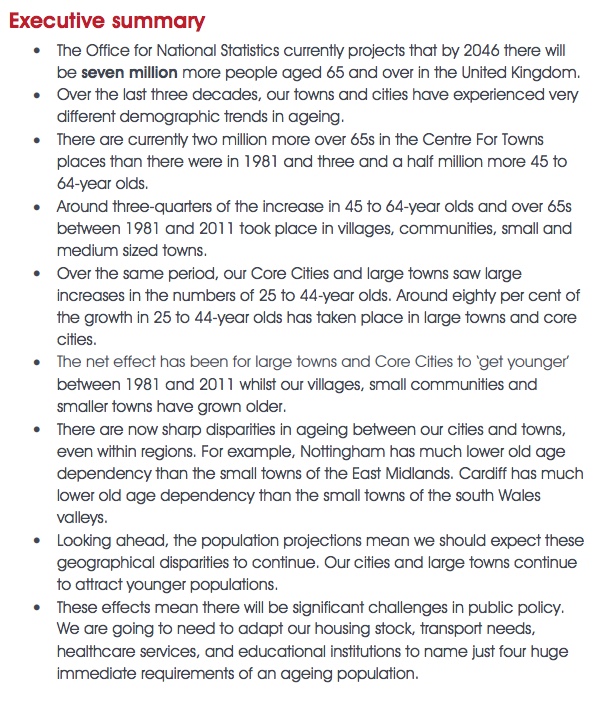
Anyone with an interest in Beeston's wellbeing and future should join the Centre's mailing list. Their first report is about the ageing of towns. Below is the report heading together with the executive summary which mentions Nottingham (which is one of the UK's 'core cities' so outside the remit of the Centre).

The report raises questions, especially in relation to Nottingham and how its tightly drawn boundaries distort data, plus the fact they treat Clifton as 'a town' (see their map below) distinct from Nottingham whilst not including Bingham or Ruddington.


Nottingham's ageing population I would argue doesn't move far. Susan and I moved from Lenton to Beeston, as have others we know. For all intents and purposes we are still in Nottingham if you ignore the local government boundary which separates the two places. These artificial boundaries distort reality. Add the towns ringing Nottingham with the city, then look at the data and I am confident that the Nottingham conurbation will not be deprived of oldies.

Within conurbations there can be distinct places which elsewhere, on their own, would be regarded as towns and should be treated as such.

I look at the map below and someone unknowing might see this as a recent creation, yet it isn't. A tram route, then a trolleybus route, followed by a bus route has been linking Ripley to Nottingham via Heanor, Eastwood, Kimberley and Nuthall since 1903. For parochial and political reasons this communal connectivity has been ignored and I hope this is something the Centre for Towns will look at — how towns and communities define themselves.


This is a captured webpage from the Centre for Towns interactive map. 

The website also includes lists of 'towns' and 'places' which show how the Centre has determined the size of a town, whether it is 'small', 'medium' or 'large'. Beeston and Long Eaton is classified as 'medium' whilst Clifton, Eastwood and Kimberley are 'small'.


I am a great believer in comparative data/ information, so I hope this will become a feature of Centre for Towns work. In other words comparing 'like' towns within each category.

I look forward to following the progress of the Centre for Towns with interest and wish it well for the future.


Nottingham Postcard Show

Always worth a visit: