Friday, 18 May 2018

Beeston Speed Map coming soon — comments welcome

I will let the new Beeston Speed Map talk for itself. If it needs explaining then it's a failure. At this stage I have a few names to enter and icons to create and add. I will also get the Middle street Resource centre and its cafe on. Each map is part of a jigsaw and they can all be joined together to create one large map if I had the money to print it A2 size (as many such maps are).

No map is ever finished.

I now have to take a copy out with me and check it for accuracy as at 31 May 2018. That is going to be my cutoff date for final corrections and editing.


Tuesday, 15 May 2018

The sheer joy of discovering a Sandiacre gem

I have walked the full length of the Erewash Canal in bits, all of it twice, some sections several times, and always wanted to divert to the church on the hill outside what we know today as Sandiacre, as you head north towards Cotmanhay and Langley Mill. Last week we finally made it and my oh my, what a church! By the far the best hereabouts. St Giles' Church is everything a parish church should be — simple, unadorned, old (part-Saxon and mentioned in the Domesday Book of 1086), and full of peace and tranquility; a place for everyone regardless of faith or, in my case, a humanist who likes to think of himself as a pagan, at home with nature and the seasons of life.

The approach is along and up a gully with no clue as to what is at the top.


The Church noticeboard at the top to the right gives a hint of what you will find, but is still nothing to see.


A 180º turn brings St Giles' Church into view and it looks impressive and its middle section offers a clue as to its Saxon origins. Simple and solid. This view is looking east.


Round to south side is the entrance. 


Steps lead down to a crypt. 


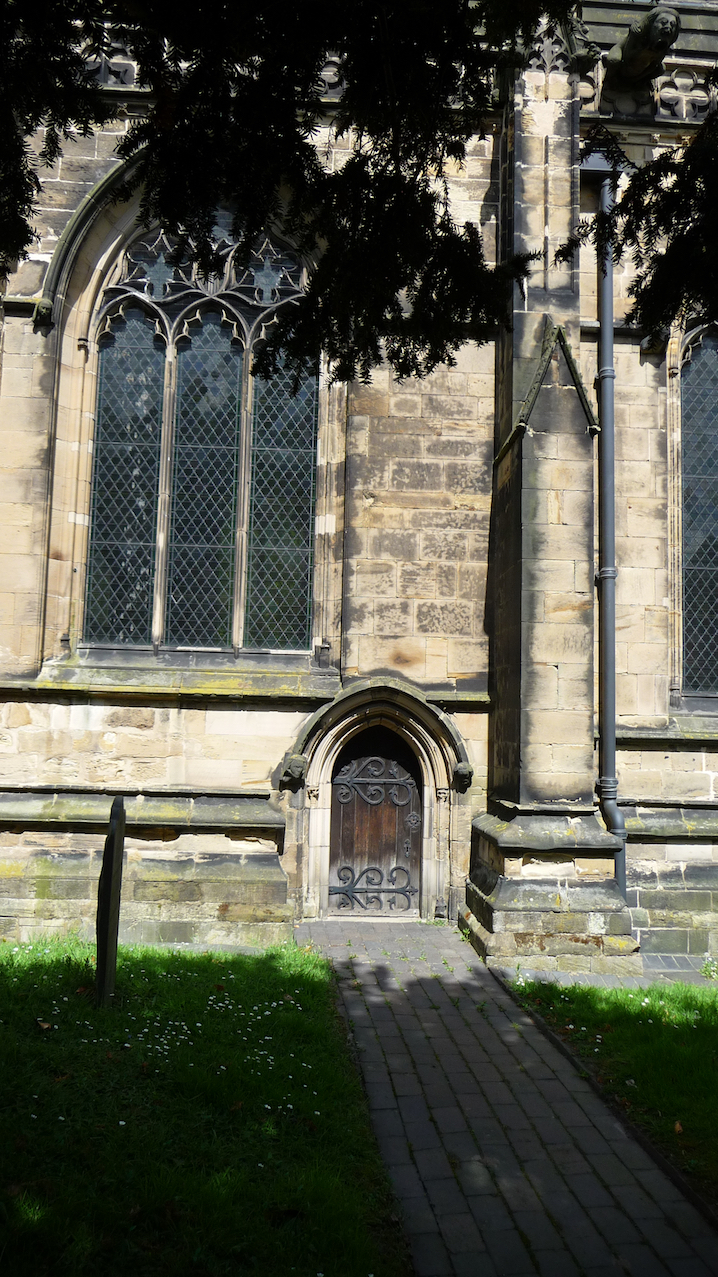
The small door dates from the 14th century and was to allow priests to enter and leave the church.


The view to the south from a gate which looks unused.


Inside the church your gaze is drawn to the right and towards the chancel. The dividing wall and window are Saxon, pre-dating the Norman nave, which 'probably dates from the 14th century' according a leaflet available inside the church.


Turn around 180º and there behind you is this very impressive organ, large enough for a cathedral yet here it is in this perfectly formed small parish church.


What stained glass there is is equally impressive.


This modern stain glass commemorates the RAF. The small window to the left at the top is Saxon in origin.


You would be hard put to anything better anywhere.


The can can be said for this three seat sedilla also dating from the 14th century.


This is the priests' door we saw earlier from then the outside. The heads on either side are Edward III and Queen Phillippa.


A view from the chancel towards the organ and the Saxon window.


The fonts also dates from the 14th century.


This close-up shows the font's fine carving.


The local dead of two world wars are remembered on these two plaques. Some surnames appear on both: Carrington and Wood. There may be others I haven't noticed.


This photograph reveals so much about the church and how it has changed. The roof was raised in the 14th century and the windows lengthened. A few diamonds of coloured glass can achieve so much.


When we left I took one look back at this remarkable church, certainly the church I would take visitors to see before any other.


Outside you can see a grass pathway that you can follow to avoid walking down the gully. It brings you out at the bottom and once you know it is there can use it to walk both up and down.


St Giles' Church is on Beeston's doorstep. The Trent-Barton i4 bus route stops very near by. It deserves to be on any Greater Nottingham visitors' map. It is, of course, also in Derbyshire whilst being very much part of Nottingham. Search it out. You won't be disappointed I promise.


Sunday, 13 May 2018

My lungs — Little miracles can happen with a little help from yourself

Three years ago almost to the day I was diagnosed with what was first described on the x-ray report to my GP as 'established fibrosis of the lungs'. I had the  x-ray at Nottingham QMC Hospital on 8 May 2015. By August 2015, after tests and scans, it had become Ideopathic Pulmonary Disease — 'ideopathic' meaning the cause of my lung fibrosis (also described as scarring of the lungs) is unknown, since I have never smoked nor, knowingly, worked with asbestos or the like. 

From 15 to 18 I worked as a trainee animal technician at the Chester Beatty (cancer) Research Institute, then in South Kensington, London, and among my responsibilities was looking after rats I put into smoking machines for varying periods of time with different numbers of cigarettes five days a week in a large shed on the roof of the building. I inhaled a lot of tobacco smoke during those years, plus what you picked up at work, on a bus, cinemas and the like. No smoking areas were few, but I avoided it the best I could: travelling downstairs on buses; in the one non-smoking carriage then on each London Underground train; going into the little room set aside in a few pubs for non-smokers.

In truth it was as good as impossible to avoid tobacco smoke and the awful smell of nicotine, it was in our homes, on our clothes (not that the latter has changed). Back in 1959 millions smoked, despite the evidence (I also killed the rats after different periods of time, pinned them out and exposed their internal organs before removing them in the presence of a lab technician to be weighed and dissected. I wish I could say that I left for ethical reasons, but I didn't despite having reached the conclusion that what we were doing was cruel to animals). Sadly all too many people still ignore the evidence about both smoking and animal experimentation. The point of telling you this story is because my lung scarring might date from my first job.

Susan would also mention my catching whooping cough in 1977, which wasn't diagnosed immediately and I ended up being ill for five months. On a good few occasions then, when every breath of air was being fought for, I thought I was breathing my last. It was the closest I ever felt to death until the second night after my open heart surgery at the end of February last year when I had some kind of post-operative infection and four people stood at the end of my bed and I wondered which one of them was going to take me, but I was in no pain, the morphine saw to that, and I felt 'other worldly', outside of myself looking on. It was a surreal experience and by mid-day, eight hours later, it was all as if it had never been. And my open heart surgery was a direct result of being diagnosed with fibrosis of the lungs — had I not had that x-ray I may have had a heart attack and died. I have a lot to thank the thoracic team at Nottingham City Hosital for).

I made the point in my first post about my condition on 21 May 2015 that having lung disease was going to be part of my life – NOT my life. There have been a few posts since about my heart condition (which it turned out I was born with and could have killed me had I been a runner, a footballer etc. and unlucky). In the event my second post about my lungs didn't appear until earlier this year when tests in January showed that my lung capacity was down to 81% and I could be prescribed NICE restricted medication for a year at first to see if the medication stabilised my condition. Last Thursday I went to the City Hospital to find out which of the medications I would be getting — the one which causes diarrhoea or the one which makes your skin sensitive to sunlight (the small booklets I was given to read about each medication seem to suggest the chances of either happening were c.10%)

On arrival at the City Hospital I was sent for a chest x-ray and a couple of breathing tests, (my last previous tests having been in January this year), followed by a brisk walk with my thoracic consultant. What I was not expecting in a million years when a few minutes later he came and collected me from the waiting room was the significance of the sheet of A4 paper he was holding. 'Good news, remarkable though not unusual. Your lung capacity has increased by 20%, so you need no medication'. He then went on the show me the test results and to give me copies of my first tests in 2015 and Thursday's tests, plus showing me my x-rays over the past three years, one after my open heart surgery showed how my chest had been wired to together, now disappearing from view. 'As you can see little difference between now and when we first saw you, really good'. We had a long chat. Good news can be as overwhelming as bad news. My consultant puts the improvement down to my exercising, lifestyle and positive attitude and the rest of the day passed in a haze. I was overwhelmed.

In three months my lung capacity has recovered from 81% to 94% — actually 1% better than I was at the time of my first tests in June 2015!

Back then the prognosis wasn't good and I fall into the camp that wants to know. In my last blog I wrote about a British Lung Foundation report about my condition and how it could be detected earlier using x-rays and I discussed this with my consultant on Thursday. Lung disease is not curable like some cancers. The most those diagnosed young enough can hope for is a lung transplant when the condition gets bad enough. You can live with it , dormant / stable for years, then a chest infection or other problems can cause it to flare up and it can quickly become terminal. My own condition declined prior to my open heart operation from 93% to 90%, then five months after the op I was at 86%. A chest infection in November laid me low for close on a month and this was reflected in my January 2018 test results, when my lung capacity was down to 81% — which why I qualified for the NICE controlled medication. Now, thanks to a little miracle in which I played a part, my lung capacity as at Thursday was measured at 94%! A fact I am still struggling to come to terms with three days later, but the fact is my good news doesn't alter the original prognosis one iota!

In fact it spurs me on to continue attending my weekly Breathing Matters exercise group every Thursday morning in The Pearson Centre on Nether Street, Beeston, a ten minute walk from where I live. Since the end of January I have walked at least 30 minutes every day* (missing a few I admit) and have been doing some after breakfast exercises for many years now. I am about to add 5 minutes worth of upper body exercises every day before tea. Not a lot, but based on my experience they can make a difference.

You may wonder why I bother to blog about this and at great length. The answer is simple enough. If one person follows my example and benefits than I would make this post every day. It matters that much. Time and again when asked how I feel I always reply 'One lucky bunny'. I may have made some of my luck, but so can we all.

NOTE: * An hour working in the garden counts as a 30 minute walk in my book — which is where I'm going now.

In the January post I went on about the importance of prevention and health care. The reason why lung disease and prevention is mostly associated with smoking is because people don't want to know if they have a incurable medical condition (smokers are the one group who do know the high risk they run). The trouble with this attitude is that by the time people to find out it's too late!  The breathlessness and tiredness they have put down to old age has reached the point where they are close to needing oxygen or, because they are lower than 50% lung capacity, they can't get the NICE controlled medications which might stabilise the disease/fibrosis.

If we knew early enough (and this is where my one lucky bunny bit comes in) then you have a degree of control. You can help yourself if you listen to what you are told and take advantage of the support you are offered. For me it's been a little bit more complicated than most, but I am evidence of how it can be for some if they know soon enough and for me this means promoting a voluntary LUNG FIBROSIS SCREENING PROGRAMME — in other words choice — just like there is with some cancer and cardiac conditions.

Our healthcare services have too many Cinderella conditions and services, so I am not about to argue for lung disease to get special attention. It is a choice we have no need to make. The answer is simple and our MPs could make the decision tomorrow if they were so determined. We are a rich country. The problem rests with our financial priorities and the truth is they are not healthcare related, nor are they to help the young get a good education or to help the poor and disadvantaged. We elect far too many self-serving MPs. At the end of the day we are the architects of our own misfortune, yet there is cause to hope. The world is full of decent, caring, people and many of them are to be found in the NHS which does a fantastic job despite the best efforts of all too many in Parliament to destroy it.

Thursday, 10 May 2018

For Judy a work in progress

Report on a work in progress. Creating a new style Beeston map is always involves tweaking. Trying to include EVERY Beeston shop into one pocket map no larger than A3 takes a little time. Here are my draft workings for the second part of the map.


Saturday, 5 May 2018

I remember a Labour and community activist whilst Liberals grab the margins from the centre and Labour flounders

A FORENOTE:

Since I made this post the following news story has been posted on The Guardian website about Clive Lewis, Jon Cruddas and other Labour Party members arguing that the Party needs to be part of a progressive alliance if it wants to defeat the Conservatives - not expelling members who do!

https://www.theguardian.com/politics/2018/may/07/labour-mps-revive-campaign-for-progressive-alliance?CMP=Share_iOSApp_Other

ORIGINAL POST BEGINS HERE:

The Labour Party in Broxtowe and nationally should look at the numbers from the BBC News website  below and tremble. The Party floundered and nearby Derby encapsulated why. The Council has appeared disconnected from local people for a long time. Watching their councillors on East Midlands Today over the years it will not surprise me if Derby goes the way of Mansfield. Another good example of how bad Labour can be. We have to learn from these things.

I am the first to recognise and accept that broad sweeps such as I am making capture the good  as well as the bad and indifferent; those Labour councillors who by sheer dint of effort keep voters loyal even in bad times; the Party members who are part of a wide spectrum of community groups and voluntary organisations. Right now such people appear exceptional when they are what we should all try to be - part of the community working alongside others regardless of politics, faith, race, gender, age. 

The results also contain the message that Labour is vulnerable to a Liberal resurgence. Soubry wants a soft Brexit and as it draws ever closer, so do a great many Labour Party members and supporters - and the Liberals are chasing the votes of Remainers/soft-Brexiteers and winning. 

Soubry is astute. We all know, thanks to the numbers game played at Westminster, she is worth a dozen other MPs when it comes to Brexit and Broxtowe voters know this. Having an MP at Westminster who counts is attractive and MPs win because of this. Notoriety beats Party time and again across the political spectrum.


Soubry has learnt when to keep quiet. Labour lost in Broxtowe because it fell into a trap of its own making.

The Labour Party habitually plays to what it believes to be its core support, all that it needs to cross the finishing line first. So much of what the Party blames the Conservatives for can be tracked back to the Labour governments of Blair and Brown. The Liberals by getting into bed with Cameron cannot escape their role in the demise of meaningful democracy.

Be it housing, health, defence, border control, austerity, law and oder, student fees, community involvement, local democracy, Labour got there first. It spent it years in office brown-nosing big business and Little Englanders because it wanted to out-Tory the Tories. I’m sure you do not need me to list examples of these painful truths. Voters know this and, understandably, reject the copy in favour of the real deal.

During the 3 plus years I have lived in Beeston I cannot recall one example of community engagement by the Labour Party. There is talk of what the Party wants to do FOR people, but never of what it wants to do WITH local residents and groups.

I am mindful and critical because I believe Labour Party members should be active in their neighbourhoods and communities. Canvassing is not the same as being involved. Party members who give their time freely are as much community volunteers as others in faith, age or gender based groups, yet they accept being set apart. In my experience councils for/of voluntary service behave like an alternative establishment and are self-serving.

Last Tuesday, 1st May, I attended a remembrance gathering in Lenton for Mairi Yuill,  a lifelong Labour Party member and community activist, a peace campaigner, a former city and county councillor loved and respected across Lenton.  I was one of three people asked by her family to say a few words. I spoke about her community involvement, having spent some 35 years working  alongside her. A close friend and ex-neighbour (Chris Richardson) spoke about her Labour Party work. Mairi died aged 95 in a Beeston nursing home, where she spent her last few months. I saw not long before she passed on, having promised her tea and cake in the Local not Global Deli. It was not to be.


Mairi at work in The Lenton Centre Office,
March 2008

My eulogy for Mairi on 1st May was as follows:


I am extremely touched by Deborah’s invitation to say a few words in remembrance of  Mairi.

For a good few of us here today this is a familiar place when it comes to remembering Mairi, because this where she held her 70th and 80th birthday parties. Was there a 60th? I wish I could remember.

Deborah told me ‘The biggest thing I learned from my mum is that I personally can make a difference, and never to accept the status quo if it is unfair’.

I found a reference to Mairi the Nottingham News No.75, dated October 1975 (which was published by striking NUJ members involed in a year long dispute with the Nottingham Post), describing Mairi and the late Peter Price as anti-establishment councillors.

Unsigned as it is, knowing Mairi and Peter from all those years ago, I do not doubt its veracity.

When Susan and I arrived in Lenton in 1980 and started going to Labour Party meetings Mairi  quickly recruited me as a volunteer for the then Lenton Community Association, which managed Lenton Community Centre. The Centre opened in February 1979 and Mairi had been secretary of its founding steering committee. Over the years, we worked on many projects together, including the creation of the Dunkirk and Lenton Partnership Forum in 1996 and the first campaign to save the Lenton Leisure Centre in 1994. There was one more in 1999, then again in 2004 before, in early- 2006, the City Council sold the building to the Association for £10 and it became The Lenton Centre. 

How many remember the community shop on Osmaston Street, where you could find Mairi most mornings during the 1990s.

From 1981–85 we were Labour Party county councillors together, both of us having previously been city councillors (Mairi in Nottingham, me in Birmingham). How could I not want to work alongside a person who believed to be a Labour Party member it was not enough to put up posters, knock on doors, deliver leaflets or run election campaigns, you had be part of the community as well and Mairi was certainly that.

After The Lenton Centre took over Mairi did not retire, as she could have reasonably done. After all she was 82. Instead she she joined the Board of Directors and took on a day job of sorts, going into the office most days of the week to help look after the accounts and membership records. It was where I usually got to chat with Mairi on the couple of day a week I visited the Centre and I took the photograph of Mairi I am proudest of — sitting at a desk working. She never stopped.

Mairi paid me and Susan the compliment of asking us to look after the records of Lenton Community Association when it transferred all its assets to The Lenton Centre. In 2016 we deposited all the files, together with our own, in Nottinghamshire Archives. At some time in the future when someone comes to write a new history of Lenton I’m sure Mairi will be there centre page, along with other Lenton heroes such as Lesley Fyffe and Jenny Hills. For my own part I can honestly say that whenever Mairi asked me to help in some way I did.

After we left Lenton for Beeston at the end of 2014 Susan and I saw very little of Mairi. Health problems took charge of our lives, but then we got some good news from Deborah; that Mairi was coming to live in Beeston within yards of our favourite cafe, so at the end of February just gone I called in at her new home and saw Mairi, promising to return, but before I could Mairi passed on. We never did have the tea and cake I promised her.

Mairi will be remembered with love and affection by all us, of that I am sure.

By their deeds you shall know them.

Robert Howard
1 May 2018.

Mairi, 2nd left, at the first Lenton Centre Board of Directors meeting. Not everyone shown.

Mairi, June 2004, at the 25th anniversary celebrations for Lenton Community Centre, with Jenny Hills to her left and Dennis Jones, Lord mayor and a former Lenton resident, to her right.


Mairi working on Lenton Community Centre's stall in the Old Market Square sometime in the 1990s when all Nottingham's community centres game together to promote their activities. In 2002 there were 46(!) community centres in the City.


Mairi takes notes at a small meeting in the Lenton Community Centre Office in the 1980s. Derek in the middle lived in the flats and founded a very successful lunch club in the Centre which ran for many years. Sadly he passed on a good few years ago. Glenn Trickey was our City Council paid Warden for many years. Probably the best community worker I've known. He was with us on 1st May.


Friday, 4 May 2018

New Beeston pocket map begins to take shape

A draft column from my new Beeston Speed map, a work in progress, which will(!*) show EVERY retail unit in the Beeston shopping area. If my diagrammatic map is as good as I hope it is, then it needs little explanation, only to say the numbered blue circles relate to Blue Plaque  locations.

!! Horror of horrors just noticed I’ve left of The Frustrated Chef! Hey ho, it is a draft, but right now that doesn’t seem like a reasonable excuse. Will correct tomorrow (Saturday).


Wednesday, 2 May 2018

A Beeston picodyssey

You might wonder if a walk along Beeston's shopping streets can be described as a 'picodyssey'. Well on a day like today, walking through the rain trying to avoid puddles I think it can. Over 100 photographs to look through, none better than the first taken where my odyssey began and ended, from the window of the Local Not Global Deli on Chilwell High Road, opposite Imperial Road where I sat and drank three cups of coffee until the rain let off enough.


The day is all part of my preparations for creating a new 'mosaic' style Beeston 'vertical map'.

Life is galloping by. It's over a month since my last post to which I have yet to add captions. I will soon. I promise.

This post will also get some more pics together with a draft of my new icons: