Showing posts with label Nottingham. Show all posts

Wednesday, 3 February 2021

The future of LocalLink bus routes L10 and L11 is up for discussion, so let's make sure we take advantage of the opportunity


Click on the map above to enlarge and to find out more, please enter 'buggy bus' in the 'Search' window in the right-hand column (about half-way down). This will link you to posts by me dating back over several years.

News posted by Borough and County Councillor Steve Carr on the Beeston Updated Facebook page that Nottingham City Council has launched a consultation into the future of LocalLink bus routes L10 and L11 will come as no surprise to those who take an interest in, and use, public transport in and around Beeston and Nottingham.

Beeston has long been a beneficiary of the City Council’s largess because it no obligations to Beeston, since we are outside the city’s boundary. I have suspected for some time that it would come to an end, given the ever deepening financial mire local government is in.

It will not be enough to argue for the status quo because, having read the consultation document and knowing the City Council wants to save £700,000 with good reason, saving the existing L10 and L11 bus routes is not an option.  What we have to do is take advantage of the consultation to look at how alternative community bus services can best be provided in and around Beeston — hence my idea for a Beeston Buggi Bus Network.

We all have to work together. This is not an issue for political point scoring!

UPDATE: Will add a link to the City Council consultation here. Click to see.


Saturday, 13 July 2019

Beeston Days Out gets another update and welcome to my Big City Map.

Maps of whatever kind are never finished. At best they are snapshots of time in a world, even here in Beeston and Nottingham, which changes daily.

Yesterday evening I was correcting mistakes and making small changes with others I still want to make. I am just hoping the Beeston Days Out banner when it arrives at the Beeston Festival later this morning is the version below (remember, click on the map to enlarge):


In addition here is a copy of what I describe of my Big City Map which first appeared in 2017 and I still regard as an achievement of sorts. I think I can fairly claim it is another unique map which I would like to to something. In the meantime explore and enjoy.


Wednesday, 6 March 2019

Beeston Transport spider map updated

My Beeston public transport map has its own page and link in the right-hand column. I have just updated it and have plans to add a collection of inset maps to highlight other locations in more detail like the two inset maps already included for Beeston town centre and Nottingham city centre. The only question is how such an enlarge map can be published? 

Click on the map to enlarge:


Thursday, 10 January 2019

National Audit Office's local government financial data including Broxtowe invites as many questions as it answers, so let's have a council budget 'Teach-in Day'

The National Audit Office has published a report, Financial sustainability of local authorities: (a) 2018 visualisation, relating to local government finances covering the period 2010/11 – 2016/17. Unfortunately it is all percentages and not actual amounts of money. On the plus side you can compare Broxtowe with Nottingham City and Nottinghamshire County Council, albeit very different beasts. I have extracted some data which I will turn into tables over the next few days.

In the meantime if you have missed this story in the news media or don't have a weblink, follow this link.

The following quote from the report's introduction delivers the message loud and clear. It is that local government and local communities who have paid the price of the financial crisis, together with those on low incomes, the vulnerable and disadvantaged. To all these people local services matter!

The Ministry of Housing, Communities & Local Government measures the impact of reducing government funding on local authority income via ‘revenue spending power’. This indicator captures the main streams of government funding to local authorities alongside council tax. We found that nationally revenue spending power fell by 28.6% in real terms from 2010-11 to 2017-18. If council tax is removed, our analysis shows that government funding fell in real terms by 49.1% from 2010-11 to 2017-18.

Here is a comparative table (click on table to enlarge).


If I had the time I would request the financial data which has been used to compile these percentages (which all appear in the report). There has been talk of Broxtowe Borough Council's financial problems. What this comparative suggests is that Broxtowe appears to be in no worse position than Nottingham or the county council.

Notice how percentage reserves have increased and you can see why this data matters in money terms. I will have a look at Broxtowe. What the figures do show is that Nottinghamshire County Council has a far lower level of reserves (in percentage terms) than Broxtowe and Nottingham, which probably helps explain the enthusiasm among some county councillors for the creation of a unitary county council (an idea since dropped, for the time being at least).

That said, the county council spends (in percentage terms) 64.6% of its budget on adult & child social care, whereas the city spends 54.5%. At this rate, as the news media tells us every few days (so it seems), the county and city will soon have little money to spend on anything else!  

Some the data is less complete for comparative purposes so I will just refer to Broxtowe when it comes to loss of Government funding and spending power.

Between 2010/11 and 2017/18 Government funding to Broxtowe fell by 62.9% and, as I understand it, will continue to fall until it reaches 0%. I'm sure when this will happen. In real times this equals 42.6% and council tax lost 3.2% of its spending power in Broxtowe during the same period.

It gives me a headache just trying to comprehend what is actually happening. We all need to understand because it is that important!

Perhaps the Labour Party might like to organise a kind of 'Council Budget Teach-in Day' a few weeks before the Borough Council elections (one day in Beeston/Stapleford and one day in Eastwood/Kimberley) with stalls and data based on services. It could well attract much need media attention!

For council tenants there could be a stall with info on 'Where does you rent go?' looking at the housing budget.  Another for leisure and parks. Then there's Environmental Services. You get the idea. Once in power the Borough Council can take over the days.

Residents can be asked for their views so that changes can be planned for. Holding budget consultations in October/November is far too late and only serves to show how little interest have in their own 'public consultation'! 

Tuesday, 8 January 2019

How the evils of transport snobbery damage the bus and the grace of the 510 electric bus

A great article in The Guardian today about getting value for money when investing in urban public transport systems (click here for link) albeit in Africa but the same logic applies to Nottingham and the UK.

This image from the article says it all:


Nottingham's tram remains a costly investment. The older units are now 14 years old and they could well last another 30 years if properly maintained, even converted to driverless when the time comes (probably closer than even I imagine — 5 years at most).

The tram though is loved by the middle class regardless of politics. They find it 'so easy to get on and off, so comfortable' as an active Labour Party member in Beeston said to me recently, oblivious to the cost and, seemingly, that Nottingham's trams are little better than cattle trucks when full.

The costs of construction in Nairobi are obviously different to those in the UK but even here they will vary considerably place to place but I'm pretty confident that the cost ratios are much the same. In other words for the same money you can have:

50km of bus ways/track.
13km of tram track.
  9km of metro railway

Once on a modern bus using reserved track the ride is as good as any tram or train and has a flexibility denied to trams and trains, yet politicians and the middle classes still prefer the latter two over the bus! 

'Oh look at me I can ride on a tram, so select, so me'.

I can only describe this attitude as public transport snobbery! 

As I have in previous posts I remain a trolleybus person loving their smooth quiet ride. Nottinghamshire County Council's electric 510 bus route between Beeston and Stapleford has a ride as good as a trolleybus and navigates streets around Stapleford with a grace you have to experience to believe. I know no other word which describes the experience better. The bus is a monster for the roads it traverses and I am in awe of its drivers. All worthy of the title 'Bus driver of the year'.


Finally this photograph from The Guardian article. It looks like a painting. I love it.


Wednesday, 12 December 2018

Did fear of a ‘urban’ -v- ‘rural’ unitary council split scupper Conservative plans for a unitary county council?

The Nottinghamshire unitary county consultation report/summary/analysis makes interesting reading, An idea that was obviously gaining ground was that the more urban councils should split from the more rural councils.

There was less support for one county-wide unitary council than two councils. To quote from the report:


‘Overall, there was much more support for two unitary councils than for one (64% favoured two, while 36% favoured one). There was also more support for two in all seven of the districts/boroughs. The views of local authority staff were somewhat more evenly divided: 47% preferred one and 53% preferred two unitary councils.’


Also:

‘A North-South split would be distinctly unpopular with political leaders across the districts. A West-East split would be much more politically acceptable because it would reflect the aspirations of local political leaders and create two ‘harmonious’ unitary authorities. A single UA – though much the best solution in terms of service delivery and financial viability – might have difficulty in achieving effective political majorities or working arrangements between the different parties The east of the county would be fearful that it was ‘subsidising’ the poorer west.’

Broxtowe depends on Nottingham and now the county’s plans are dead Nottingham can happily back off and there will be no more talk of mergers with surrounding councils by the city, although the county’s more urban councils might still like to be free of the county’s more rural councils.

Perhaps a Broxtowe-Ashfield-Gedling (eventually unitary) ‘partnership’ council might emerge from all this, able to work with the city, given they share so many common interests. We shall see.


In the meantime a link to the consultation report:


http://www.nottinghamshire.gov.uk/media/1727147/opinionresearchservicesreport.pdf


The following two tables from the Report may be of interest (click on images to enlarge):


Notice that some of those responding lived in Nottingham. Some Voluntary sector participants were of the view that district and parish councillors were more supportive of their activities than county councillors — hence the opposition to one unitary Nottinghamshire council.


Notice to low level of participation in the survey by younger people. Older folk are cursed for participating and blamed for determining the future of young people. In truth, younger voters hold the future in their own hands. They had every bit the same opportunity as a 70 year old to participate. Maybe we need to wear badges saying 'I'm voting. Will you?

Sunday, 28 October 2018

Map showing Council Tax Band 'A' charges in Broxtowe Borough and Nottingham City councils.

A map which speaks for itself. Beeston Band 'A' council tax payers transferring from Broxtowe borough Council to Nottingham City Council will, at the 2018/2019 charge rate, pay an extra £71 per annum, assuming the City Council's unitary charge matches the £885 levied by Nottinghamshire County Council onto Beeston Band 'A' council tax payers.

Usual thing, click on map /table to enlarge


I created the Council Tax chart below in August 2018:

The Broxtowe Council Tax charges are as for Beeston. As the above map shows these charges vary across Broxtowe because of charges levied by town and parish councils. 

Because Beeston's services are provided by two councils there has to be additional admin charges. By Beeston joining Nottingham there will only be one council managing council services and we should be as beneficiary of this.

Wednesday, 24 October 2018

A new graphic Beeston - Broxtowe - Nottingham ward map – a work in progress


I still have some graphic tweaking to do but I think the motorway and the railway lines are self evident. The orange lines show where buses go to and from Beeston including Derby Road and Queens Road as both are in Beeston wards and its historic parish. One thing is startling clear — no buses go to the north of Broxtowe Borough.

Once you start looking at Beeston in relation to Broxtowe Borough it becomes clear that the links with Nottingham are social, historic, cultural, economic, and with Nottingham University too. 

Yet another important link between Beeston and Nottingham is the new proposed Parliamentary constituency of Nottingham West AND Beeston. The fact that boundary commissioners accept the link adds weight to the argument that come the demise of Broxtowe Borough Council Beeston should join with the already unitary Nottingham City Council and not the proposed unitary Nottinghamshire Country Council.

The other great advantage of joining with Nottingham (given that Broxtowe Borough Council's days are limited — hence the Conservatives supporting Nottinghamshire County Council's plan to merge with all the county's district councils to create a unitary council) is that the City Council is already a unitary council and for Beeston to join the City will save a whole load of money.

Over the coming days and weeks I will develop my arguments, even get a banner made of this map and it spin-offs. I believe maps and graphics make the case I am arguing easier to understand.

Comments welcome.  I am planning to add ward electorate numbers and Band 'A' council tax rates (the largest band).

I hope you find this map interesting. Updates will follow next week. For the next few days I have other things I need to do.

Robert Howard

Saturday, 25 August 2018

Making sure we all have a say in the future of Beeston and compiling a dossier of comparative data


The boundary marker dated 1933 which you can see on Broadgate and is within sight of Beeston town centre — that is how close Beeston is to Nottingham (historically, the parish of Lenton, which voted to become part of the then Nottingham Borough Council in 1877). Given the opportunity, will Beeston vote to do the same?

The following piece by me appears in the latest edition of the Beeston & District Civic Society Newsletter, but first what does not appear is the table below showing council tax band charges by local authority and location in and around Nottingham. Because of parish and town council charges, different rates are paid depending on where you live. My list uses the council tax rates applicable to the urban areas which may decide to go with Nottingham rather than the county.

I would prefer that Beeston joins with Nottingham City Council and not Nottinghamshire County Council, should Broxtowe Borough Council be abolished, simply because Beeston is part of the same conurbation as Nottingham and has more in common with the city than Bingham, Mansfield, Newark, Retford or Worksop, for example.

Click on the table to enlarge.


Nottingham's council tax charge is, for band D, £106 higher per annum than Beeston (£2.03 per week), but Beeston residents benefit directly from many city services and facilities (subsidised bus routes, such as the L10 and L11, theatres and museums, Highfields Park, the tram, so the list could go on). These are all points and arguments you will hear and read about many times over the coming months.

I strongly believe that should Nottingham City Council decide to make a counter proposal to the county council's it will do so in a way which which gives Beeston more control over its own affairs and that has to be a good thing by any measure. 'Partnership working' in some form has to be the way forward. 

Now, the piece by me which appears in the latest edition of the Beeston & District Civic Society Newsletter:

Who will decide Beeston’s future?


On 12 July 2018 Nottinghamshire County Council proposed the creation of a unitary ‘doughnut’ county council. This would result in the abolition of all the county’s district councils. Nottingham City Council would continue to exist in splendid isolation. 

Should the County Council’s proposal reach the point where it is formalised, Nottingham City Council has indicated it may submit a counter proposal to extend the city’s boundary to create what can best be described as a ‘Greater Nottingham City Council’ covering the conurbation.

What does all this mean for Beeston?

Well, to some extent, that will depend on us.

Do we see the County Council’s proposal as none of our business, a threat or an opportunity?

For my part I see it as an opportunity.

To begin with, a reading list which might be helpful, so that a historical perspective can be part of our reasoning. I would like to suggest five titles, one of which I have yet to find a copy:

The Illustrated History of Nottingham’s Suburbs by Geoffrey Oldfield, published by Breedon Books, 2003.

A History of Basford Rural District Council, 1894–1974 by Geoffrey Oldfield, published by Basford R.D.C., 1974.

A Centenary History of Nottingham Edited by John Becket, Manchester University Press, 1997.

Local Government Reform, Urban Expansion and Identity: Nottingham and Derby, 1945–1968 by R P Dockerill, School of Historical Studies, Leicester, 2013 (https://lra.le.ac.uk/handle/2381/28203).

The fifth title, What Shall We Do With the Erewash Valley? by (Stapleford) Councillor Stanley Woods, 1947, is a pamphlet I have yet to read, but it is quoted in R P Dockerill’s thesis*. It interested me because chairing the Midlands Regional Museums Service in the 1970s and East Midlands Airport in the 1980s led me to the conclusion that we need a ‘twin city’ approach to the Derby/Nottingham conurbation and that there could be some merit in a Erewash/Browtowe unitary council acting as a buffer between the two city councils, should any future partnership arrangement come about. Stanley Woods seems to have understood this 70 years ago.

* See his reference Hancock Local Government Commission Consultation with local authorities: Nottingham County Borough Council (National Archives search ref. T 184/298). 

The map I have included provides a web link to an excellent Phd dissertation by R P Dockerill. 

Together, what all these writers make plain is that proposed local government changes to boundaries and powers rarely happen, and when they do the outcome can be less than satisfactory. The late Geoffrey Oldfield, a respected and well known local historian who lived in West Bridgford, wrote in the Introduction to his Illustrated History of Nottingham’s Suburbs: ‘The urban districts and smaller parts of rural districts (around Nottingham) escaped becoming administratively part of the city in 1974. Under local government re-organisation they were absorbed into four new district councils. This did not affect the reality of their affinity to the city as suburbs’ (hence 14 entries for suburbs outside the city, including Attenborough, Beeston, Bramcote and Stapleford, complete with excellent potted histories).

A Centenary History of Nottingham contains an excellent chapter/essay: ‘The government of the city, 1900–1974: the consensus ethos in local politics’ by Nick Hayes, which ends with a brief reference to how we ended up with ‘post-1979 conviction politics’. In reality, the halcyon consensus days of local government were coming to end in the 1960s, with the abuse of aldermanic elections and the exclusion of opposition councillors from new style policy committees on some councils (aldermen with votes were abolished in the 1970s).

I admit to being no fan of, exclusive, conviction politics and believe that, when it comes to government, consensus works best, and I see this as one of the prizes to be won if local government is re-organised in and around Nottingham. How we elect councillors and councils has to be part of the outcome. I believe the London Assembly, Scottish and Welsh proportional added member voting system should be extended to include England too.

For this to happen, all of us need to understand, and engage, in the entire process. Too many local and national politicians have narrow agendas which exclude the wider community. The decimation of towns like Beeston, be it the townscape or what it can decide for itself, can be reversed. Now is the opportunity we have never had before.

I believe Beeston & District Civic Society could play a leading role in the process, perhaps organising a public briefing on the proposals and the history of local government change in the Beeston area over the past 100 years.

Understanding the past is the best way to ensure a better future for Beeston.

Robert Howard
beestonweek.blogspot.com

799 words.

CAPTION TO PHOTOGRAPH:

A rusting extant City of Nottingham boundary marker on Broadgate, in sight of Beeston town centre.

Sunday, 22 July 2018

Where would draw the line if you were creating a council to replace Broxtowe Borough Council?

Over the past week I have had about a dozen conversations about the future of Beeston and Broxtowe. Not one person has opted to become part of a unitary Nottinghamshire local authority comparable to Nottingham City Council in status. Most agree with me that Broxtowe as a council has never made sense. Several have mentioned joining up with Long Eaton (and by default, Erewash Borough Council). Given the close working relationship there has been between the two councils (sharing backroom services and staff) it is an idea with some merit if the cross-county nature of such a council could overcome those who see county boundaries as set in stone.

'Erewash stretches from Little Eaton to Long Eaton'. The impression this creates is rather different to the geographical reality. Like Beeston and Eastwood, the two places have no direct link unless you follow rivers. In other words, as presently defined Erewash makes no more sense than Broxtowe, but what the map below shows is that a council centred on the Erewash Valley would make geographical sense and from this follows political sense.

If you don't want to go in with Nottingham even though we are part of the same conurbation, then you have to look for links, and geography and the urban area to the west and and north-west of Beeston offer an option. The question is where would you draw the lines if you were trying to keep Beeston separate from Nottingham?

Click on the map to enlarge.


Over the next week I will add some data about council tax, population and registered voters for Erewash, Broxtowe and Nottingham.

Friday, 13 July 2018

Change is afoot - what side are you on? City or County?

Yesterday's meeting of Nottinghamshire County Council was, potentially, a very important meeting for the future of Beeston (and the rest of Broxtowe Borough for that matter).

According to a BBC News report, the County Council voted to take over the powers of the county's district and borough councils to create a county council area based unitary authority. No maps were provided, so I have created my own: 

Click on text/maps below to enlarge. This way the maps can be copied as a block:


Back in the 1980s I was a Labour Party county councillor for the then ward of Portland (covering Highbury Vale, Old Basford and Stockhill) in  Nottingham, which was then just a district council like Broxtowe. It wasn't until 1997 that Nottingham became a unitary council and I, like lots of others, had campaigned long and hard to bring this about.

The county council in my time was riven with petty divisions based on geography. I suspect it is the same now, with decisions about Beeston being made by councillors living 40 miles away in Worksop and Retford. My view then was to go with what local county councillors wanted and not County Hall. I did one term (1981-85) and had a good time with good jobs (chairing East Midlands Airport, the Youth & Community sub-committee and having the arts brief on Leisure Services), but even in the Labour Group there was too much wheeler-dealing for me and I thought it madness that Nottingham had to be part of it. 

Logic says that Nottingham should have a boundary which incorporates the conurbation. Beeston has far more in common with the city than it does with the county and it is a beneficiary of the city in so many ways.

The county council by its decision yesterday has provided Beeston with a golden opportunity to recognise that it is part of Nottingham is so many ways and to contribute to its future development.

I will actively support a counter proposal from the City Council to merge with surrounding urban areas (accepting that this will include rural pockets) and I hope many others will do the same. 

Over coming weeks and months I will take part in the debate. One thing is sure, it will be an issue in next year's Broxtowe Borough Council elections. No change is not an option.

There are caveats. There will have to be local referendas across the county based on localities, not wards*. Maybe 3 choices:

★ No change.
★ Go with the county.
★ Merge with the city.

Historically, such matters have been decided by central government and Parliament.

I would also like all voters to have a say in how the new council of whatever complexion is elected:

★ No change, stay with first past the post voting.
★ Change to the added member system of proportional representation used in Scotland and Wales.
★ A transferable vote system.

*So in the case of Beeston it would be the total vote for Beeston — Attenborough, Bramcote, Chilwell and Stapleford voters would have their own ballots.

It may be 3 or 4 years before change happens and I have not mentioned another option I quite like — Broxtowe and Erewash boroughs merging to create a 'third force' in the Derby–Nottingham conurbation. The councils already work together.

I will watch the debate develop with interest.

In the meantime this link might be of interest: https://lra.le.ac.uk/handle/2381/28203


Dr. Dockerill's thesis is full of maps and tables. The one below relates to 1952 how one one writer saw 'Greater Nottingham' as an area. Nottingham much different to my own take above, except I have included Bestwood and Papplewick as well. 


It is an exhaustive history which actually go back further than the title of the thesis would suggest, as the following map dated 1919 shows:


In other words the debate about how local government is organised in the Nottingham area has been ongoing. The evidence in favour of a larger city/conurbation council area was as cogent in 1919 as it now.

Friday, 25 May 2018

Non-NHS care on the NHS and political sloganising

Yesterday afternoon I spent four hours at the QMC Hospital’s privately owned Treatment Centre having a inguinal hernia repaired under a general anaesthetic.

I visited my GP on 9 April (six weeks ago) about a problem first diagnosed in June 2016 but at the time I was waiting to have open heart surgery, so the surgeon wasn't keen, for understandable reasons, to operate on my hernia until 18 months after my heart op. In the event this pushed back the hernia op until August 2018. The solution was to wear a support belt during the day, but most days began with me pushing my inguinal hernia back inside, usually more than once. By the beginning of this year (2018) it had become quite painful at times, so I started to keep a hernia log and decided to visit my GP sooner rather than later on the basis that I wanted to have my hernia op at the first opportunity.

The private Treatment Centre adjacent to the QMC Hospital saw me on 18 April and I had my pre-op assessment the next morning, thanks to the fact that the 8.30 a.m. appointment is difficult to fill. My hernia didn’t stop me walking or exercising, so I walked from Beeston to the Centre each time. At the end of last week I was offered a cancellation for yesterday at 2.30 p.m. which I willingly accepted. So here I am at home 12 hours later recovering, feeling fine and taking it easy, doing this post. Tomorrow I plan to walk into Beeston, then home after a coffee.

The Treatment Centre treated me like royalty from beginning to end, mirroring the heart and lung care and support I have been receiving from Nottingham City Hospital for the past three years. With my hernia fixed I hope I am now at the beginning of a long Indian summer. I’m 74 and never felt better in so many ways, but I am not complacent. I have to stay active and I am enjoying exercise now more than I ever have. I feel more creative. From where I am sitting writing this I can see my runner beans growing and the last of the blue bells, the garden has been awash with them this year.

Now back to the point of this post. Circle Health says of itself if you visit their website: The Circle Nottingham NHS Treatment Centre is the largest day-case centre in Europe. It operates under a Standard Acute Contract, providing a wide range of outpatient, inpatient, diagnostic and therapeutic services. It is the only independent sector facility in the UK to offer teaching and research, including pre- and post-graduate medical, nursing and AHP training. Its surgery has been rated "outstanding" by the Care Quality Commission.

It is also a private company listed at Companies House and has had its moments in the media. I am politically opposed to any public service / utility being in the private or voluntary sector with the exception of mutuals in which users and workers are joint owners. I feel able to say this having worked first as a Family Planning Association (FPA) clinic volunteer over 50 years ago, then 12 years with the British Pregnancy Advisory Service (BPAS) followed by 21 years with Advance Housing & Support, all charities providing healthcare related services local government and the NHS failed to provide in large swathes of England. All these organisations budgeted to make surpluses but not to pay shareholders directly. However all of them took out bank loans on which they paid interest and, therefore contributes to 'profits'.

Labour politicians have actively encouraged private healthcare so we have to be cautious when condemning private healthcare. At the point of treatment, in my experience, there is no distinction between public, private or private. Many charities are now led by managers paid a 'market-led wage' little different to the private sector.

I have long favoured the issuing of bonds offering a fixed annual return for a fixed period of time as a way of enable small savers to invest in public services and utilities, so that their need to borrow from banks can be minimised.

At the end of the day it is easy to sloganise when it comes to healthcare and public services if you give little thought to the consequences, then there taxes on our income, purchases, property and wealth!

Taken altogether, this is why I believe we need to arrive at a cross-party bipartisan agreement — something I have blogged about before — when it comes to the NHS, welfare and housing (and I'm pleased to say that our MP Anna Soubry agrees with me on the NHS, but struts like a Tory when it comes to housing).

I managed to live 71 years before needing to draw down on 47 years of National Insurance payments (money which was not ring-fenced). It annoys when the media and politicians talk about our 'rising older population' and ignore the fact that as a percentage so is the working age population.

What concerns me is the quality of all lives and this is not simply about age, it is about income and wellbeing, and I know for a fact that even at 74 on a relatively low income I am one of the lucky ones!

Tony Blair had a plan to improve the lot of working people and it failed big time, but I do not doubt his intent.

Wednesday, 17 January 2018

Centre for Towns website goes live

In the last couple of days the website of a new think tank, the Centre for Towns, has gone live.  One of its founders is Lisa Nandy, the Labour MP for Wigan, someone I have a great deal of time for.

The Centre describes itself as an independent non-partisan organisation dedicated to providing research and analysis of our towns and points out that cities receive a good deal of attention (and) that there should be equal attention paid to the viability and prosperity of our towns.

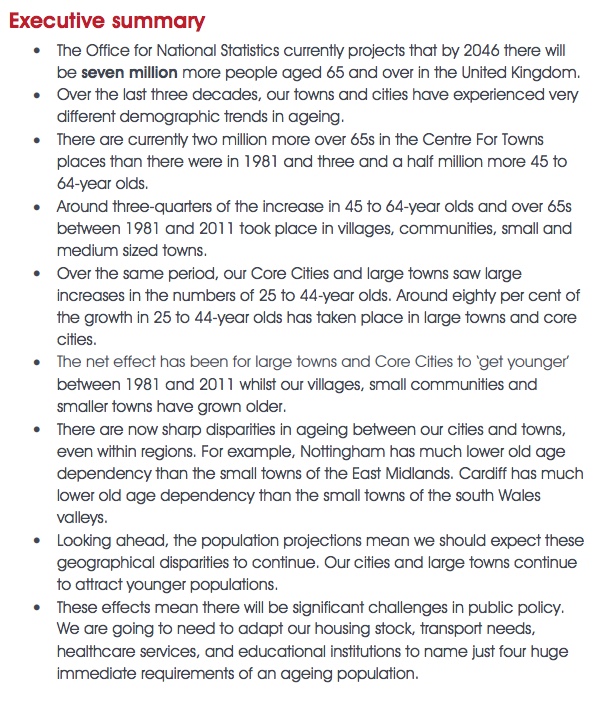
Anyone with an interest in Beeston's wellbeing and future should join the Centre's mailing list. Their first report is about the ageing of towns. Below is the report heading together with the executive summary which mentions Nottingham (which is one of the UK's 'core cities' so outside the remit of the Centre).

The report raises questions, especially in relation to Nottingham and how its tightly drawn boundaries distort data, plus the fact they treat Clifton as 'a town' (see their map below) distinct from Nottingham whilst not including Bingham or Ruddington.


Nottingham's ageing population I would argue doesn't move far. Susan and I moved from Lenton to Beeston, as have others we know. For all intents and purposes we are still in Nottingham if you ignore the local government boundary which separates the two places. These artificial boundaries distort reality. Add the towns ringing Nottingham with the city, then look at the data and I am confident that the Nottingham conurbation will not be deprived of oldies.

Within conurbations there can be distinct places which elsewhere, on their own, would be regarded as towns and should be treated as such.

I look at the map below and someone unknowing might see this as a recent creation, yet it isn't. A tram route, then a trolleybus route, followed by a bus route has been linking Ripley to Nottingham via Heanor, Eastwood, Kimberley and Nuthall since 1903. For parochial and political reasons this communal connectivity has been ignored and I hope this is something the Centre for Towns will look at — how towns and communities define themselves.


This is a captured webpage from the Centre for Towns interactive map

The website also includes lists of 'towns' and 'places' which show how the Centre has determined the size of a town, whether it is 'small', 'medium' or 'large'. Beeston and Long Eaton is classified as 'medium' whilst Clifton, Eastwood and Kimberley are 'small'.


I am a great believer in comparative data/ information, so I hope this will become a feature of Centre for Towns work. In other words comparing 'like' towns within each category.

I look forward to following the progress of the Centre for Towns with interest and wish it well for the future.


Wednesday, 4 October 2017

New 35 History Bus Leaflet

My new 35 History Bus leaflet will be printed next week for launching at the Lenton Priory Martinmass Fair on Saturday 14 October 2017. My only disappointment is that I have had to reduce the font size to get everything in and there are fewer images than I would like, but I do produce the leaflet to a budget — hence the leaflet being A3 size and not A2 size.  Usual rule applies. Click on the images to enlarge.